Showing posts with label Smithsonian. Show all posts
Showing posts with label Smithsonian. Show all posts
Friday, May 8, 2009
Eye Level view of Greene & Greene
Here's a drive-by post just to point out that the American Art Museum's blog posted an entry about the Greene & Greene exhibition with a different picture than any of the others I've seen (of furniture no less!) so head on over there and check it out.


Wednesday, April 29, 2009
American Picture Frames: Choices by Artists and Collectors
According to the Smithsonian American Art Museum’s website, “Carrie Rebora Barratt is Curator of American Paintings and Sculpture, and Manager of The Henry R. Luce Center for the Study of American Art at The Metropolitan Museum of Art.”
Last night, however, she was the speaker at the latest edition of the museum’s Collectors’ Roundtable series: American Picture Frames: Choices by Artists and Collectors. She spent a good portion of her time discussing the renovations they have just completed or are starting at the Met, but she did go into some detail about choices that have been made regarding the frame of a very high profile Met painting: Washington Crossing the Delaware by Emanuel Gottlieb Leutze.
The painting was acquired by the Met in 1897. A picture from 1910 shows the painting in a great old frame, but in pictures from 1917, that frame is already gone. That said, the curators weren't satisfied with just their own archival photos and they decided to do some more research.
Further archival research was done to determine the sort of frame that the artist would have preferred to see on the work. The Met turned up pictures from the New York Historical Society that showed the painting the same year it was painted (just after the Civil War) and the wild Federal Revival frame the artist had commissioned for it in a fit of mid-19th century nostalgia. They have commissioned a reproduction of that frame to show in their new galleries starting in 2011. Keep your eyes peeled for this because it’s truly something else—gilded with a huge carved rampant eagle on the top. Here’s a brief story about it from the New York Times that doesn’t have nearly enough pictures.
Though Barratt touched briefly on the craftsmanship required to create such a frame and professed to appreciate frames as works of art in themselves, it seemed clear that at heart, she truly is a paintings person and not so much a craft person. After all, her focus was what the artist would have wanted to see on their picture and not what the framer would have considered most appropriate. And she was fairly dismissive of collectors who change frames to suit their interior design.
This was underscored in a conversation I had with an American Art Museum docent during the reception after the lecture. Apparently getting docents for the American Art portion of the museum is much easier than getting docents for the Renwick. I had been under the perhaps mistaken impression that craft had gained more respect in museum-world than it appears that it has, at least among scholars and docents.
The final lecture of the spring series takes place Tuesday, May 19th when Dr. Walter O. Evans, major collector of African American art will discuss Collecting Outside the Canon.
Wednesday, April 15, 2009
The treasure in our backyard
Having the Smithsonian in our backyard is real gift that most of us take for granted. Not only do we get great exhibitions like the Greene & Greene show I wrote about a few weeks ago, we also have a ton of educational opportunities and experts right nearby.
Take today, for instance. I got an email from a customer wondering what to do about a Nakashima dining table she needs restored. She wanted to know if we could help her with it. Now, we’re pretty good, but we’re not conservators. Though I’ve had a lot of luck having my own flea market finds refinished by our expert finishers, I think even they would hesitate before taking on a Nakashima table.
The reason I knew this was that I went to a Smithsonian program last year about American craft where they gave some auction estimates for Nakashima, Maloof and other modern studio furniture makers’ pieces. Some were, to put it mildly, astronomical and sometimes value can be hurt by refinishing.
So rather than send her the name of our standard refinishing guy and call it a day, I decided to find the phone number for the Lunder Conservation Center at the Smithsonian and see if they could recommend someone. Thanks to the Smithsonian’s Twitter person, I got a name and a phone number and met a very nice woman named Julie who put our customer in touch with their conservators. All this took less than half an hour.
So lucky me. I get to make a local phone call the little museum in our backyard and put our customer in touch with some of the foremost furniture conservators in the world.
Wow.
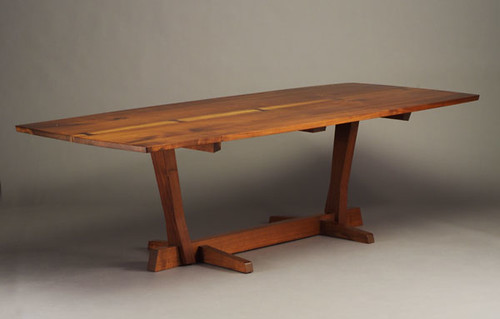
Nakashima dining table (not the customer's)
Friday, April 3, 2009
Greene & Greene at the Renwick
Two weeks ago, I made it out to the Renwick Gallery to see the Greene & Greene show. After some slight confusion on my part as to where it’s actually located (hint—it’s right behind the Old Executive Office Building), I was quite pleased with the quality of the exhibition, but since I had gotten lost, I didn’t have enough time to read everything before the museum closed for the night.
Not only did they have a great collection of letters and photographs, they also showed some of the original architectural plans. The level of detail the Greenes went to on those plans was quite OCD—plans for all the lighting, furniture, stained glass—very much in the vein of Frank Lloyd Wright. These were architects with Vision.
As usual though, my favorite part was the furniture. Of course, pictures can't do it justice. It's so difficult to reproduce the glow of wood photographically, especially when you add 100 years of patina. So here are some of the highlights courtesy of the Gamble House website.

Charles Sumner Greene
Breakfast table, 1899
Douglas fir, cedar, oak, mahogany, and birch
Wedding present for his wife, Alice
Guardian Stewardship
Photograph courtesy of Sotheby’s, New York

Greene & Greene
Desk chair, ca. 1905
Ash
Adelaide A. Tichenor house, Long Beach, 1904–05
Guardian Stewardship
Photograph courtesy of Sotheby’s, New York

Greene & Greene
Hall chair, 1907
Mahogany and ebony
Made by Peter and John Hall
Dr. William T. Bolton house, Pasadena, 1906–07
Guardian Stewardship
Photograph courtesy of Sotheby’s, New York

Greene & Greene
Bookcase, ca. 1912
Mahogany, ebony, and glass
Made by Peter and John Hall
Cordelia A. Culbertson house, Pasadena, 1911–13
Los Angeles County Museum of Art,
Gift of Linda and James Ries in memory of
Dorothy and Harold Shrier
(AC1997.105.1)
Photography © 2007 Museum Associates/LACMA
Most of these pieces are from their early to mid-career, but what surprised me most about this later piece was how modern it looks. Take away the leaded glass and it really starts to look more like part of the Modernist movement than the Arts & Crafts movement.
All in all, the best way to see these pieces is in person. So if you're anywhere near DC, I highly recommend that you check out the exhibit before it closes on June 7th. Here's the Smithsonian page on the exhibition, with a link to the online exhibition produced by the Gamble House.
Subscribe to:
Posts (Atom)


